
Courtesy and first contact
By the end of this part you can walk up to somebody you have never met, give your name, ask for theirs, say where you are from, admit what you did not catch, repair it, and leave without the conversation going cold.
The book
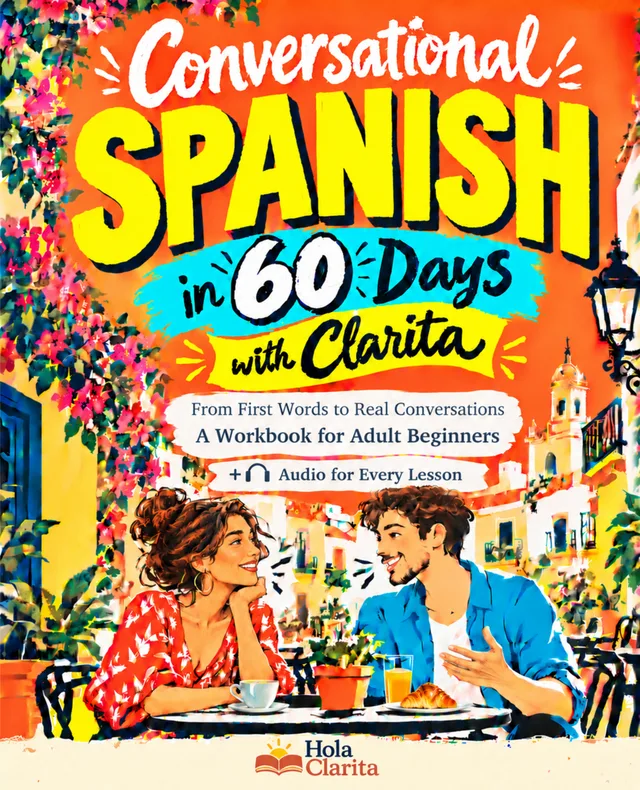
From First Words to Real Conversations — A Workbook for Adult Beginners
Sixty short lessons, one everyday moment each. Ten minutes a day, and you say every phrase out loud before you move on. Free audio for every lesson, opened by a code printed beside its title.
Both editions are on Amazon: 194 pages · 7.5 × 9.25 in · write-in space for every drill, and the Kindle edition, which reads on any kindle device or app, and on a phone or tablet. The audio is free with either one — an app membership is separate, and the section below explains how.
Who it is for
The problem is rarely vocabulary. It is that nothing has ever made you speak. This book is built for the reader who wants to talk to a partner’s family, a coworker, or a stranger at a market — and not just collect words they never use.
It assumes you are starting from nothing, or from a school Spanish you have mostly forgotten. There is no grammar table to memorise before you are allowed to speak: each lesson gives you the phrases for one moment, and you say them out loud on the same page you meet them.
Ten minutes is enough for a day, and stopping is part of the method. There is no streak to protect and no penalty for a missed day — a box you tick when the lesson is done, and the next one waiting.
What the sixty lessons cover
Each part is ten lessons, and each part opens with a promise about what you will be able to do by the end of it. Those promises are the book’s own, and they are the honest shape of the course.
By the end of this part you can walk up to somebody you have never met, give your name, ask for theirs, say where you are from, admit what you did not catch, repair it, and leave without the conversation going cold.
By the end of this part you can describe your own day: what you do before nine, where you go, who is at home, and how often you do any of it.
By the end of this part you can walk into any place that serves food and come out fed, with the bill paid and nothing misunderstood.
By the end of this part you can ask a price, find your size, try something on, and pay without handing over a card and hoping.
By the end of this part you can ask where something is, buy a ticket, check into a room, and say what has gone wrong when it has.
By the end of this part you can talk to somebody for two minutes, find something worth saying, and end it well.
How a lesson works
Every lesson is two pages and always the same shape, so you are never learning the format instead of the Spanish: the phrases, a short dialogue that uses them, three drills you write in the book, and a note from Clarita on the part that catches almost everyone.
Every answer is in the back, so you always know whether you got it right. That is the whole design: say it, write it, check it, and move on tomorrow.
Hello, and the two ways to say you. The book opens in a small shop in the afternoon, where someone greets you before you have decided what to say back. These are the first three of the ten phrases it gives you for that moment.
The other seven phrases, the dialogue they belong to, and the drills are in the book — and you can hear every one of them read aloud, for free, on the lesson’s audio page.
Audio and the app
These are two different things, and the difference matters before you buy.
The audio comes with the book. Point your phone at the code beside a lesson title and you get that lesson’s phrases and dialogue read aloud. There is nothing to install, no account to make, and no limit on how often you listen.
The app is a separate product with its own subscription. Hola Clarita is the course the book came out of: the same method, with a tutor who briefs each session, corrects what you write and say, and brings back whatever is still shaky. Buying the book does not include a membership, and nothing in the book needs one. If the method suits you, the app is where it continues after lesson sixty.
There is no native accent at the end of this book, and it will not pretend otherwise. What it gives you is a working Spanish: you hold a real conversation, you are understood the first time, and you stop translating in your head before you speak.
Quick answers
No. The book is complete on its own: sixty lessons, the answers to every drill in the back, and free audio for each lesson opened by the code printed beside its title. Nothing in it requires an account.
No — they are two separate products. The book is a one-off purchase on Amazon, and the app is a subscription with its own seven-day trial. You can use the book for the whole sixty days and never open the app.
Yes. Every lesson has its own page with the phrases and the dialogue read aloud, and there is nothing to install and no account to make. The code beside each lesson title opens it.
Latin American Spanish — the everyday Spanish you will actually hear, rather than the Spain-first Spanish of older textbooks. It uses tú by default and flags usted where the situation calls for it.
Yes. Lesson one is two ways to say hello and the two ways to say you. Ten minutes is genuinely enough for a day, and a missed day is a blank box rather than a broken streak.
Everything you learn in the book works in the app, and it keeps going after lesson sixty. Seven days free for new members, and you can cancel any time before the trial ends.
Start your free trial